
Pearls of Data: Predictive Phenotyping in Oysters
by Reyna Ibarra
My name is Reyna Ibarra, and I am second year undergraduate pursuing a B.S. in Biology at Oregon State University with concentrations in Marine Biology and Ecology (expected graduation 2028). Additionally, I am an URSA undergraduate research fellow in the Gurr Lab for winter and spring of 2026. In this blog post, I will summarize my experience where I participated in a USDA-funded research project measuring the metabolic activity of oyster larvae using resazurin. Currently, I am interested in research related careers in marine biology and conservation. I also hope to involve myself with sustainability-focused opportunities.
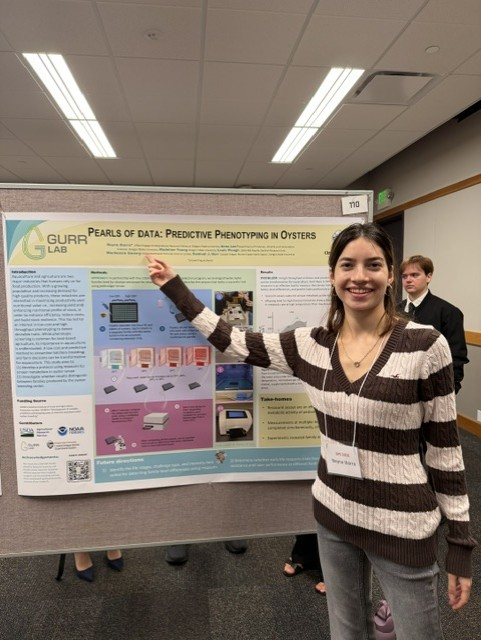
Reyna presenting her poster at the URSA Engage research symposium in Spring 2026
In partnership with USDA Agriculture Research Service’s Pacific Oyster Genomic Selection (POGS) program in Newport, our lab leveraged biparental oyster larvae selectively bred for resistance to Ostreid herpesvirus. Our goal was to investigate cost-effective methods to rapidly screen metabolic rates between families. Predictive phenomics is a critical tool in agriculture and aquaculture industries to identify, select, and breed for maximized productivity and nutritional value. In particular, metabolic rate assays are commonly used to assess desirable traits in land-based agriculture; however, its importance in aquaculture remains understudied. A low-cost and high throughput predictor to streamline hatchery breeding can be transformative and forecast success at the farm and product outcome for growers. Resazurin is of rising interest in aquaculture as a rapid phenotyping tool. A non-toxic fluorescent dye sensitive to redox reactions, blue resazurin undergoes a chemical change by accepting electrons and irreversibly reducing to the highly fluorescent pink resorufin. The intensity of fluorescence from conversion to resorufin is proportional to the live cellular activity, or in our case the metabolic activity of oyster larvae. To determine if resazurin is a cost-effective and informative method for screening aquaculture models, we (1) developed a standard protocol to collect data in oyster larvae and spat and (2) investigated whether results differ between families.’
To this end, we examined the metabolic activity of twelve distinct oyster families during their larval development. Our chosen families represented an even split of parentages from low to high disease tolerance, or estimated breeding value (EBV) determined by their parents’ survival to disease challenges. Metabolism was measured using controlled incubations in resazurin at four temperatures: 26°C (at which larvae were grown in the hatchery), 30°C, 34°C, and 38°C. This range of thermal stress encompasses the known aerobic window for oysters and their transition from aerobic to anaerobic metabolism.
A poster was published on FigShare to guide interested parties on the procedure we used to measure oyster larvae metabolism using resazurin.
Results showed larvae offspring from parents with high EBV, and thus likely more disease resistant, had a more pronounced peak and subsequent decline in metabolic rates at high temperatures than larvae offspring from low disease resistant parents. These findings suggest that under high thermal stress, oysters of high EBV families may shift from aerobic metabolism toward partial anaerobic metabolism because oxygen demand exceeds supply. Resistant oysters are rapidly activating metabolism under stress before switching to a low metabolism state which creates unfavorable conditions for diseases such as osteoid herpesvirus
Further, our project highlights that resazurin assays are an effective tool to screen metabolism and detect family differences with the possibility of forecasting farm success and disease resistance. Given the benefits of predictive phenomics in agriculture, further research on the importance for bivalve aquaculture can (1) identify the life stage, challenge type, and intensity best suited to discern families using resazurin, (2) to determine whether early life resazurin data forecasts later response to disease challenges and their performance on farms, and (3) pair resazurin with an assay panel of metabolites and proteins to develop correlative insights.
After engaging in research with the Gurr Lab for winter and spring of 2026, I have gained so many valuable skills that I hope to carry along into my professional career. This experience has shown me just how thrilling laboratory experiments and professional research can be. I am much more confident in my decision to pursue a career in marine biology. Now that I have seen potential career paths related to life science, I would love to become a marine biologist working with organisms in the field. As always, I have told myself that research is a dream goal to pursue; however, I previously never performed it in a professional setting. Now more than ever I am determined to continue on my path of becoming a scientist.
